8. Risk Management
Risk management is "…the process of identifying, evaluating, selecting, and implementing actions to reduce risk to human health” (Commission 1997a). Risk management can involve a combination of decisions based on science, policy, and professional judgmentDecisions made based on knowledge gained through education and experience., as well as social, political, and economic concerns. These decisions can occur prior to, during, and after completion of a risk assessmentAn organized process used to describe and estimate the likelihood of adverse health outcomes from environmental exposures to chemicals. The four steps are hazard identification, dose-response assessment, exposure assessment, and risk characterization (Commission 1997a).. The relationship between risk assessment and risk managementThe process of identifying, evaluating, selecting, and implementing actions to reduce risk to human health and to ecosystems. The goal of risk management is scientifically sound, cost-effective, integrated actions that reduce or prevent risks while taking into account social, cultural, ethical, political, and legal considerations (Commission 1997a). at first seems simple and linear, with the risk assessment informing risk management; however, risk assessment and risk management are interconnected (Figure 8-1).
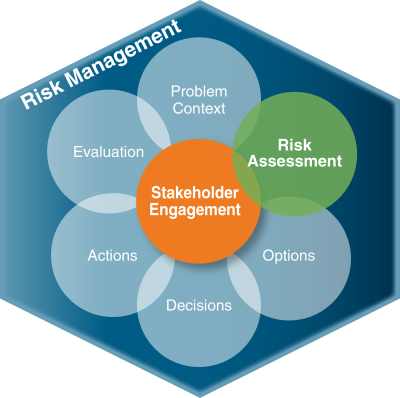
Figure 8-1. Risk management process.
Source: Adapted from (Commission 1997a)
Often, individuals associated with risk management decisions come from different entities that may have different perspectives on the definition of risk and on cleanupThe assessment and reduction, removal, or control of chemicals in environmental media. Cleanup is synonymous with other terms such as "corrective action" and "remediation" used in various state, local, and federal programs.; these entities can include the potentially responsible party, federal environmental regulators, state environmental regulators, state or local health departments, tribes, and the affected public. One of the reasons that risk management can be so difficult is that it must balance the perspectives and interests of many people.
This chapter reviews the relationship between risk assessment, risk management, and sustainability and discusses key issues that may affect the risk assessment development. The key issues are organized around three general topic areas:
Risk Management in Project Planning
Using Risk Assessment to Inform Risk Management
- Accounting for Changes in Scientific Understanding or Land Use Since the Risk Assessment was Completed
- Full Consideration of the Uncertainty in Numerical Risk Estimates
Other Factors in Risk Management
8.1 Risk Management in Project Planning
Usually the project managerAn individual from a regulatory agency (for example, federal, state, or local), or a consulting company, or responsible party company, who is coordinating the site cleanup including the risk assessment. plays a critical role in project planning. Implementation of a formal project planning process as discussed in Chapter 3 can be an effective approach to managing risks associated with the preparation of a health risk assessment that will be used to support environmental risk management decisions. Chapter 3 provides guidance on managing risks associated with the basic elements of a risk assessment and ensuring that the risk assessment meets or exceeds regulatory requirements. Two areas in which the project manager should focus risk management efforts include identifying the appropriate regulatory context and defining the problem statement in a manner that is technically and scientifically sound, and consistent with the regulatory context and the interests of stakeholdersA stakeholder is anyone who has a “stake” in the development, outcome or decisions made as a result of a risk assessment. A stakeholder can be a person, a group, or an organization that is either affected, potentially affected, or has any interest in the project or in the project’s outcome, either directly or indirectly (Commission1997a; Commission 1997b; NRC 1996; NRC 2009)..
8.1.1 Issue – Identify the Appropriate Regulatory Context
Section 3.1.3 discusses regulatory context and a useful approach to accounting for the statutes, regulations, policies, guidance, and recommendations that form the regulatory framework within which a risk assessment is prepared. As discussed in Section 3.1.1.1, multiple agencies or programs may have some jurisdiction, and therefore the project manager should identify the controlling regulatory context for the site.
 Option – Establish the Jurisdiction for Site Decisions and Understand the Pertinent Regulations, Policies, and Guidance
8.1.1.1 Option – Establish the Jurisdiction for Site Decisions and Understand the Pertinent Regulations, Policies, and Guidance
The project manager should clarify the relevant jurisdiction for the site. This process may involve contacting federal, state, or local agencies, which may include the state environmental regulatory agency as well as local pollution control districts, health districts, fire districts, or other agencies charged with maintaining environmental and public health and safety. The appropriate jurisdiction and regulations applicable to the risk assessment for a specific site should be reflected in the risk assessment. A memorandum of agreement between agencies or other formal documentation of the regulatory authority may be warranted.
Option – Ensure that the Risk Assessment is Prepared Using the Appropriate Regulations, Policies, and Guidance
8.1.1.2 Option – Ensure that the Risk Assessment is Prepared Using the Appropriate Regulations, Policies, and Guidance
After verifying the lead agency, project managers should ensure that the risk assessment is prepared following the appropriate regulations policies and guidance for the site. Often, health risk assessments are prepared incorrectly, using exposureContact of a receptor with a chemical. Exposure is quantified as the amount of the chemical available at the exchange boundaries of the organism (for example, skin, lungs, gut) and available for absorption (USEPA 1989a). assumptions and models that were developed for a regulatory program other than the program that applies to a given site. For example, the default indoor air exchange rate applicable to vapor intrusion modeling under USEPA differs from that under Cal/EPA oversight.
8.1.2 Issue – Define the Problem Statement
Developing an accurate problem statement is a critical first step in formulating the risk assessment and is consequently the first part of a systematic planningA planning process that is based on the scientific method. It is a common-sense approach designed to ensure that the level of detail in planning is commensurate with the importance and intended use of the data, as well as the available resources. Systematic planning is important to the successful execution of all activities at hazardous waste sites, but it is particularly important to dynamic field activities because those activities rely on rapid decision-making. The data quality objective (DQO) process is one formalized process of systematic planning. All dynamic field activities must be designed through the use of systematic planning, whether using DQO steps or some other system. See also Data Quality Objective (USEPA 2015h). approach such as USEPA’s DQO process (USEPA 2006c); see Section 3.3.1. A problem statement is a succinct description of an issue or the issues to be addressed in the risk assessment. The problem statement should focus the risk assessment approach and provide the context for managing project riskProject risks include any uncertain events or conditions that have the potential to adversely affect a project’s objectives, scope, time, cost, or targeted primary outcomes, or to result in unintentional adverse outcomes., as well as for the environmental risk present. Defining the problem statement shares many activities in common with development of the CSM (Section 3.2). Both involve gathering and interpreting information on historical site operations, current and future land use, and physical site characteristics.
Option – Consult the Stakeholder Groups
8.1.2.1 Option – Consult the Stakeholder Groups
Section 3.1 provides information on identifying and engaging stakeholders in the risk assessment. When stakeholder groups are vocal, engaged, and have an expectation that their interests will be considered, the project manager can benefit from consulting with these groups upfront to develop an acceptable problem statement. Consulting stakeholder groups during planning helps to develop a risk assessment that addresses key stakeholder concerns. Project managers should research the social, political, aesthetic, and economic considerations that could affect risk management decisions. Such information can be obtained from scoping meetings open to the public. Other options include contacting local leaders or advocacy groups active in the area, or the owners or lessors of property adjacent to the site. These efforts are not necessary for every risk assessment project, but ensuring that the right stakeholders are involved in defining the problem supports successful project solutions.
Option – Assemble a Complete Technical Project Team
8.1.2.2 Option – Assemble a Complete Technical Project Team
Assembling a team with the appropriate expertise as part of project planning is essential. The nature of the subject matter experts may vary for specific projects, but commonly includes individuals with expertise in toxicology, risk assessment, data evaluation, statistics, and chemistry. Other disciplines such as hydrogeology and atmospheric dispersion modeling may also be relevant.
Option – Meet with the Team to Identify Data Gaps
8.1.2.3 Option – Meet with the Team to Identify Data Gaps
In some instances, the project manager or a stakeholder is given the opportunity to review the problem statement only after the project has already moved forward (for example, they receive a final risk assessment report for review). If the project manager or stakeholder does not concur with the problem statement that served as the foundation for the environmental investigation and risk assessment, then project delays could ensue. In these instances, the most timely and cost effective option may be to meet with the project team that was involved in the investigation to learn their perspective first hand. Sometimes, the project team simply may not have described the problem statement adequately. Talking directly with the team may save time and avoid lengthy back-and-forth written communications.
Option – Agree to Disagree
8.1.2.4 Option – Agree to Disagree
Sometimes not all stakeholders concur with an aspect of the problem statement. At times, it may not be possible to gain full team or stakeholder consensus on every aspect of the problem statement. In these instances, the project manager should determine whether the point of disagreement is something that would affect the site remedy. If not, then the team can maintain this point of disagreement in the official records for the project, and move forward to address the site remediation. If so, then the project manager must weigh the facts in order to best meet the needs of the majority of the stakeholders and to protect human health and the environment in accordance with the regulatory framework.
8.2 Using Risk Assessment to Inform Risk Management
As described in Chapter 7, the risk characterizationThe risk characterization integrates information from the preceding components of the risk assessment and synthesizes an overall conclusion about risk that is complete, informative and useful for decision makers (USEPA 2000c). consists of both the numerical estimates of hazard and risk and an evaluation of the uncertainties and biases that may be inherent in the risk assessment. Both the numerical risk assessment results and the uncertaintyThe lack of perfect knowledge of values or parameters used in a risk assessment. Uncertainty may be reduced by collection of additional data. analysis must be considered when using a risk assessment to inform site management decisions.
8.2.1 Issue – Accounting for Changes in Scientific Understanding or Land Use Since the Risk Assessment was Completed
Scientific understanding of nearly all aspects of risk assessment is continually evolving and state and federal risk assessment guidance is also subject to change. This process can result in changes to risk assessment methods and inputs, most commonly with respect to toxicity valuesDerived values (for example, reference doses and slope factors) that can be used to estimate the incidence or potential for adverse human health effects in receptor (USEPA 2015h). and exposure factorFactors related to human behavior and characteristics that define the time, frequency, and duration of exposure; and help determine an individual's exposure to a chemical (USEPA 2011b). assumptions. The most current and applicable information should be reflected in risk management decisions for contaminated sites, but it is not always practical, economical, or even necessary to revise a risk assessment due to these changes. To some extent, the CERCLA process formally acknowledges that scientific understanding evolves over time and requires that some previous site decisions be reviewed every five years to ensure continued protection of human health and the environment.
Similarly, land use and activities at a site are also subject to change over time. Changes in land use can affect the exposure assumptions and parameters selected for the risk assessment.
Option – Have Ongoing Communication between Project Managers and Risk Assessors
8.2.1.1 Option – Have Ongoing Communication between Project Managers and Risk Assessors
Project managers must communicate with risk assessors (see Section 3.1.2) regarding potential scientific changes that may affect the conclusions and recommendations of the risk characterization. When risk management decisions are being made some time after a risk assessment is completed, the risk assessor should review the assessment to determine whether significant changes in science or policy affecting the risk assessment have occurred. Ideally, a framework for accommodating these changes should be part of project planning and should balance the need for consistency and certainty within the regulated community and stakeholders with recognition that science and science policy are continually advancing.
Risk assessors may also be aware of soon-to-be-released information affecting certain facets of the risk assessment and can give the project managers notice regarding pending significant changes. For example, before toxicity values are updated in USEPA’s IRIS, the chemical-specific risk assessments undergo external peer review and USEPA lists the projected schedule for finalizing these assessments. The risk assessor may let the project manager know that a draft IRIS assessment is expected to be finalized soon, and how the draft value could impact the risk characterization results.
Option – Perform a Qualitative or Semi-Quantitative Evaluation of the Updated Information
8.2.1.2 Option – Perform a Qualitative or Semi-Quantitative Evaluation of the Updated Information
As indicated in Section 4.5.1.1 and Section 7.2, the human health risk assessment may require updates over time. However, an update to a toxicity value or an exposure parameter value does not necessarily mean that the risk assessment calculations must be revised and the assessment reissued. These changes may not be pertinent to the scenarios or chemicals that are driving a specific risk management decision. There may be opportunities to perform a qualitative or semi-quantitative evaluation of the potential effect that the updated information would have on the risk characterization. For example, relatively small changes in assumptions regarding drinking water ingestion rates may not need to be updated in the risk assessment for a site where the remedial decision is based on direct-contact soil exposure pathways. Or, an oral reference dose may be revised to show a 10% increase in toxicity, but the existing risk assessment indicates that this chemical contributes only a small fraction to the hazard indexThe sum of more than one hazard quotient for multiple substances and/or multiple exposure pathways. The hazard index is calculated separately for chronic, subchronic, and shorter-duration exposures (USEPA 1989a).. The risk assessor can quickly verify and document that the change in the toxicity value does not affect the results and conclusions of the risk assessment.
8.2.2 Issue – Full Consideration of the Uncertainty in Numerical Risk Estimates
When using the risk assessment results to support risk management decisions, a project manager may require that the risk characterization provide more than the upper-bound risk assessment results (for example, the RME cancer risk). Since risk assessments incorporate uncertainties and bias, sole reliance on the upper-bound risk estimate may provide adequate characterization of all relevant information and potential exposures to manage risks.
Option – Qualitatively Evaluate the Uncertainty in the RME Risk Results
8.2.2.1 Option – Qualitatively Evaluate the Uncertainty in the RME Risk Results
Protective and appropriate risk management decisions for a site must account for the potential uncertainties and bias that are inherent in the quantitative risk estimates. Therefore, uncertainty surrounding risk drivers should be evaluated for the pertinent media, exposure pathways, and any assumptions inherent in the methods used. A project manager may request that the risk assessor include a clear discussion (or table) in the risk characterization, which lists each area of uncertainty in the risk assessment along with an estimate of the potential for this uncertainty to result in overestimating or underestimating risk. These estimates may be organized by the major components of a risk assessment as described in this guidance (data evaluation, toxicity, and exposure assessmentThe determination or estimation (qualitative or quantitative) of the magnitude, frequency, duration, and route of exposure (USEPA 1989a).).
While the numerical risk estimates are important factors in the management of the site, the uncertainty assessment is equally important in informing the risk management decision. A well-documented uncertainty assessment should address the major uncertainties in the risk estimates relative to the CSM, including the exposure scenarios and receptors. The relationship between uncertainty and conservative bias should be considered in applying the uncertainty assessment in risk management. For example, as discussed in Chapter 5, conservative assumptions and models used by USEPA in developing toxicity criteria for IRIS (USEPA 2013b) reflect science policy for managing uncertainties in chemical dose-response relationships for a range of possible human receptors based on imperfect data. The various uncertainties and their potential bias inherent in a risk assessment that should be considered in risk management are discussed in earlier chapters of this document.
Option – Calculate Both RME and Central Tendency Exposure Risk Results
8.2.2.2 Option – Calculate Both RME and Central Tendency Exposure Risk Results
Section 6.1 describes the concept of RME in the context of the exposure assessment as protective of public health and representing a plausible individual exposure. The risk assessment may also include an evaluation of central tendency exposure, as recommended in USEPA risk assessment guidance (USEPA 1992c). The central tendency exposure represents a median or average exposure concentration within the potentially exposed population. The purpose of calculating the central tendency exposure risk estimate is to provide a measure of the degree of conservatism associated with the RME result. If use of either the central tendency exposure or RME result supports the same risk management decision, then there may be a relatively high degree of confidence in that decision. However, if the target risk level lies between the central tendency exposure and RME result, then the risk management decision may be more difficult and the influence of other aspects of the uncertainty analysis should be integrated in the exposure assessment.
Option – Perform a Probabilistic Evaluation of the Uncertainty
8.2.2.3 Option – Perform a Probabilistic Evaluation of the Uncertainty
Probabilistic risk assessment, as described in Section 7, is a technique in which single values for the input parameters to the risk assessment calculations are replaced with probability distributions for the parameter values. For example, rather than using a single estimate of the mean concentration of a chemical in an exposure mediumEnvironmental medium containing concentrations of a chemical that may be contacted by a receptor., a probabilistic risk assessmentA technique that uses statistically derived distributions of input values (for example, exposure factors) to calculate a range of risk. would use a probability distributionA distribution describes the probability or likelihood of any potential value. for the mean concentration. The value of a probabilistic risk assessment in supporting the uncertainty analysis lies in its ability to identify the location of the RME risk estimate within the overall distribution of risk results. USEPA guidelines for exposure assessment place the RME between the 90th and 99.9th percentiles of the risk results for the exposed population (USEPA 1992c). By providing a distribution of risk results, a probabilistic risk assessment allows a project manager to determine whether the RME risk result falls within this range, or where it lies relative to another metric.
A project manager should be aware that a probabilistic risk assessment does not necessarily require the collection of additional data or other cost-intensive inputs. If there is sufficient information to estimate both central tendency and RME values for a parameter, then it is likely that a probability distribution can also be developed for that parameter.
8.3 Other Factors in Risk Management
8.3.1 Issue – Integrating Factors in Addition to the Risk Assessment to Support Risk Management Decisions
Project managers must understand and balance the results and recommendations from a risk assessment with other considerations and communicate how this information was used to form the basis of their decisions. Different states may have different inputs and policies for this process, particularly for identifying and selecting a remedial alternative.
Option – Use Available Guidance to Identify Other Factors
8.3.1.1 Option – Use Available Guidance to Identify Other Factors
Social, economic, and ecological issues associated with the specific site should be considered along with the results of the risk assessment when making risk management decisions. At the federal level, USEPA has established nine criteria for helping project managers select among different remedial alternatives (USEPA 1988a; USEPA 1997f). These criteria may not be applicable in all circumstances or in a specific state, but they provide a general framework for identifying and integrating inputs other than human health risk and regulatory criteria in risk management decisions. These criteria include community acceptance, short-term and long-term effectiveness, reduction of toxicity or mobility, and cost.
More recently, USEPA has provided an overview of other considerations to integrate with risk assessment in the final Framework for Human Health Risk Assessment to Inform Decision Making (USEPA 2014f). This document includes discussions of environmental justice, sustainability considerations, and cost-benefit analysis that were not explicitly addressed in the earlier documents. A discussion of the changing definitions of risk assessment and risk management, and the relationship between them, is provided in ITRC’s guidance (ITRC 2008).
Option – Apply Sustainability as the Organizing Principle for Risk Management
8.3.1.2 Option – Apply Sustainability as the Organizing Principle for Risk Management
More recently, the concept of sustainability has been introduced as a specific attribute of effectiveness that seeks to maximize the benefits of remediation, rather than simply focusing on achieving minimal risk. Sustainability is described as the creation and maintenance of conditions under which humans and nature exist in productive harmony (NRC 2011). “The focus on [minimizing] risk sometimes includes risk-risk and risk-benefit trade-offs in management decisions, but does not” always include “the social (including health), ecological, or economic pillars of sustainability” (NRC 2011). ITRC’s Green and Sustainable Remediation: A Practical Framework (ITRC 2011a) provides project managers with a process and tools to systematically consider relevant sustainability issues for a specific project.
Option – Facilitate Stakeholder Acceptance
8.3.1.3 Option – Facilitate Stakeholder Acceptance
Section 3.1 provides information on identifying and engaging stakeholders in the risk assessment. Beyond the regulatory context, environmental risk management often involves social, political, aesthetic, and economic considerations that project managers must balance accordingly. Although risk assessors tend to regard their work in technical terms and succeed in developing risk assessments that are compliant with regulatory requirements and scientifically correct, the methods and assumptions that form the basis of a risk assessment may ignore or discount other important factors of risk management described in Section 8.3.1.1 and Section 8.3.1.2. Facilitating stakeholder acceptance may involve integrating these other factors to acknowledge stakeholder concerns and risk perception. Risk communication issues relevant to this process are discussed in Chapter 9.
8.4 Resources and Tools
The following resources and tools were not cited in the sections above and are included here for further information.
Risk Assessment and Risk Management in Regulatory Decision‐Making. Final Report (Commission 1997b)
Alternatives for Managing the Nation’s Complex Contaminated Groundwater Sites (NRC 2013)
Publication Date: January 2015